
Legal Tyre Tread Depth in the UK What 1.6mm Actually Means
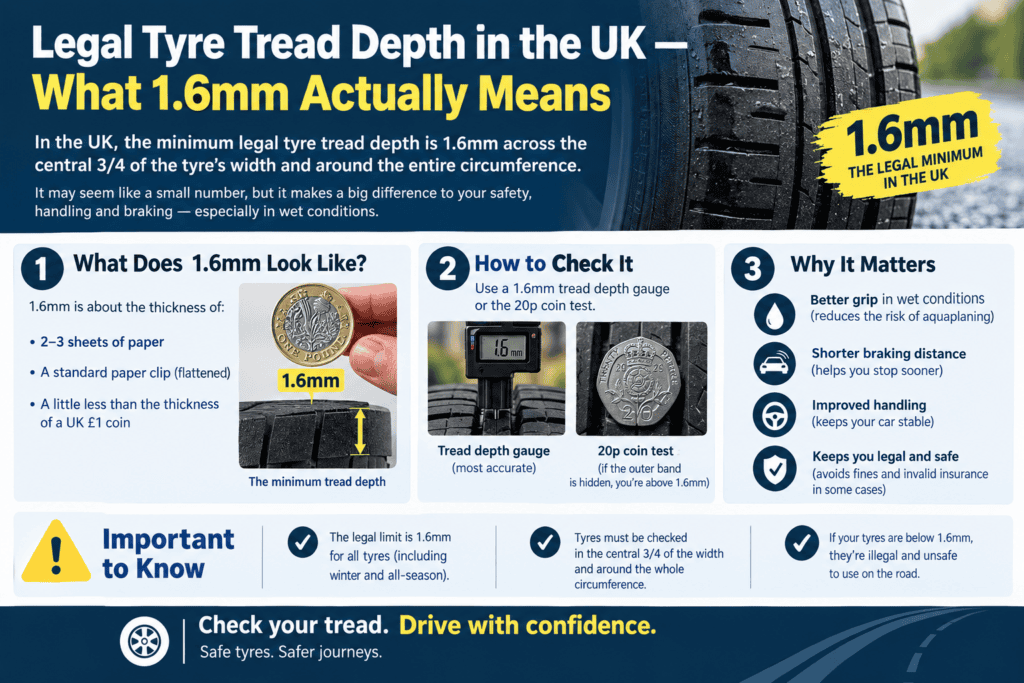
The UK legal minimum tyre tread depth is 1.6mm. That part most drivers know. What catches people out is where that 1.6mm has to be measured, and how expensive it gets if a tyre falls below it.
The legal requirement in full
For cars, vans and trailers up to 3,500kg, the tread must be at least 1.6mm deep across the central three-quarters of the tyre’s width, and around the tyre’s entire circumference.
Both parts of that matter. A tyre can have plenty of tread on the shoulders and still be illegal if the centre is worn. Equally, a tyre that measures fine at one point can be illegal if it is worn through on the other side of the wheel — which is common where alignment is out.
The penalties
An illegal tyre carries a fine of up to £2,500 and three penalty points. That is per tyre. Four bald tyres is theoretically £10,000 and twelve points, which is more than enough for a driving ban.
An illegal tyre is also an automatic MOT failure, and insurers can take a dim view of a claim where the car was not roadworthy.
How to check your tread depth
The 20p test is the quick version. Insert a 20p coin into the main tread grooves. If you cannot see the outer band of the coin, you have more than 1.6mm and the tyre is legal. If the band is visible, the tyre is close to or below the limit and needs inspecting properly.
Better still, use a tread depth gauge — they cost a couple of pounds and give you an actual number. Measure in several places across the tyre and at several points around it, because uneven wear is exactly what the coin test tends to miss.
Every tyre also has tread wear indicators moulded into the grooves — small raised bars at 1.6mm. When the tread is level with those bars, the tyre is at the legal limit.
Why 1.6mm is the legal limit, not the safe one
1.6mm is the point at which a tyre becomes illegal, not the point at which it stops performing. Wet braking distances increase substantially once tread drops below around 3mm, because there is less groove volume to clear water from under the contact patch.
Plenty of safety organisations recommend replacing at 3mm for that reason. Whether you do is your call, but it is worth knowing that a tyre at 2mm is legal and still noticeably worse in the wet than a new one.
Frequently asked questions
What is the legal tyre tread depth in the UK?
1.6mm across the central three-quarters of the tread, around the entire circumference, for cars and light vans.
How much is the fine for illegal tyres?
Up to £2,500 and three penalty points per tyre.
Does the 20p test actually work?
As a rough check, yes. If the outer band of the coin is hidden in the main grooves, you are above 1.6mm. It will not catch uneven wear, so a proper gauge is better.
What tread depth do new tyres have?
Typically around 8mm for a new car tyre, though it varies by model and type.
Is 2mm tread legal?
Yes, 2mm is above the 1.6mm limit and therefore legal — but wet grip is already significantly reduced compared to a new tyre.
Need help with your tyres?
📞 Call 07888 861557 · 💬 WhatsApp 07459 623445
Flat tyre, blowout or a tyre that keeps losing pressure? CarPal comes to you — at home, at work or the roadside — anywhere in the UK, 24 hours a day.
Related Tyre Services: Mobile Tyre Fitting,Puncture Repair