
How to Check Your Tyre Pressure Properly
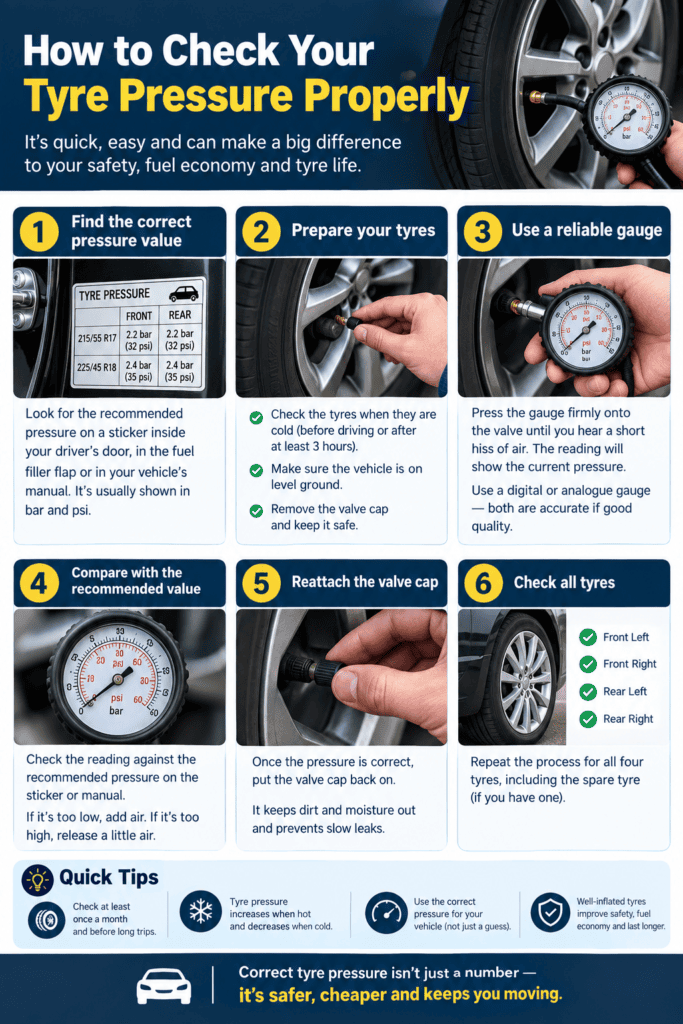
Checking tyre pressure takes about four minutes and is one of the few pieces of car maintenance that genuinely pays for itself in fuel and tyre life. Most people do it slightly wrong, usually by checking warm tyres. Here is the correct method.
What you need
Either a forecourt air machine, or a home gauge and a foot pump. A decent digital gauge costs a few pounds and is more accurate than most petrol station machines, which take a hammering and are often out of calibration.
The step-by-step method
- Check pressures first thing, before driving, or after the car has stood for at least two hours.
- Find the correct pressures on the driver’s door frame sticker, the fuel flap, or in the handbook.
- Unscrew the valve cap and keep it somewhere you will not lose it.
- Press the gauge or air hose squarely onto the valve until the hissing stops — a poor seal gives a false low reading.
- Read the pressure, then add or release air until it matches the manufacturer’s figure.
- Refit the valve cap and repeat on all four tyres, plus the spare.
Why cold tyres matter
Air expands as it heats. A tyre checked after twenty minutes of driving can read 3 to 5 PSI higher than the same tyre checked cold. If you set your pressures from a warm reading, you will end up under-inflated once the tyres cool.
If you have already driven to the garage, note that your readings will be slightly high. Either accept it and re-check at home another day, or add the manufacturer’s figure and accept a small margin of error.
Common mistakes
Using the figure printed on the tyre sidewall. That number is the tyre’s maximum safe pressure, not the pressure your car wants. It is almost always far higher than the correct figure.
Forgetting to refit the valve caps. They keep dirt and moisture out of the valve core, which is what stops slow leaks developing.
Ignoring the spare. Check it whenever you check the others.
Frequently asked questions
Should I check tyre pressure hot or cold?
Always cold. Drive no more than a couple of miles beforehand, or check before you set off.
Is the number on the tyre sidewall the pressure I should use?
No. The sidewall figure is the maximum the tyre can safely take, not what your car requires. Use the door sticker.
Are petrol station air machines accurate?
Often not. They get heavy use and are rarely calibrated. A cheap digital gauge kept in the glovebox is usually more reliable.
What if one tyre keeps losing pressure?
That is a slow puncture, a leaking valve, or a corroded wheel rim. It will not fix itself. Get it inspected — a repair is far cheaper than a new tyre.
Need help with your tyres?
📞 Call 07888 861557 · 💬 WhatsApp 07459 623445
Flat tyre, blowout or a tyre that keeps losing pressure? CarPal comes to you — at home, at work or the roadside — anywhere in the UK, 24 hours a day.
Related Tyre Services: Mobile Tyre Fitting, Puncture Repair