
What Should My Tyre Pressure Be? A Straight Answer for UK Drivers
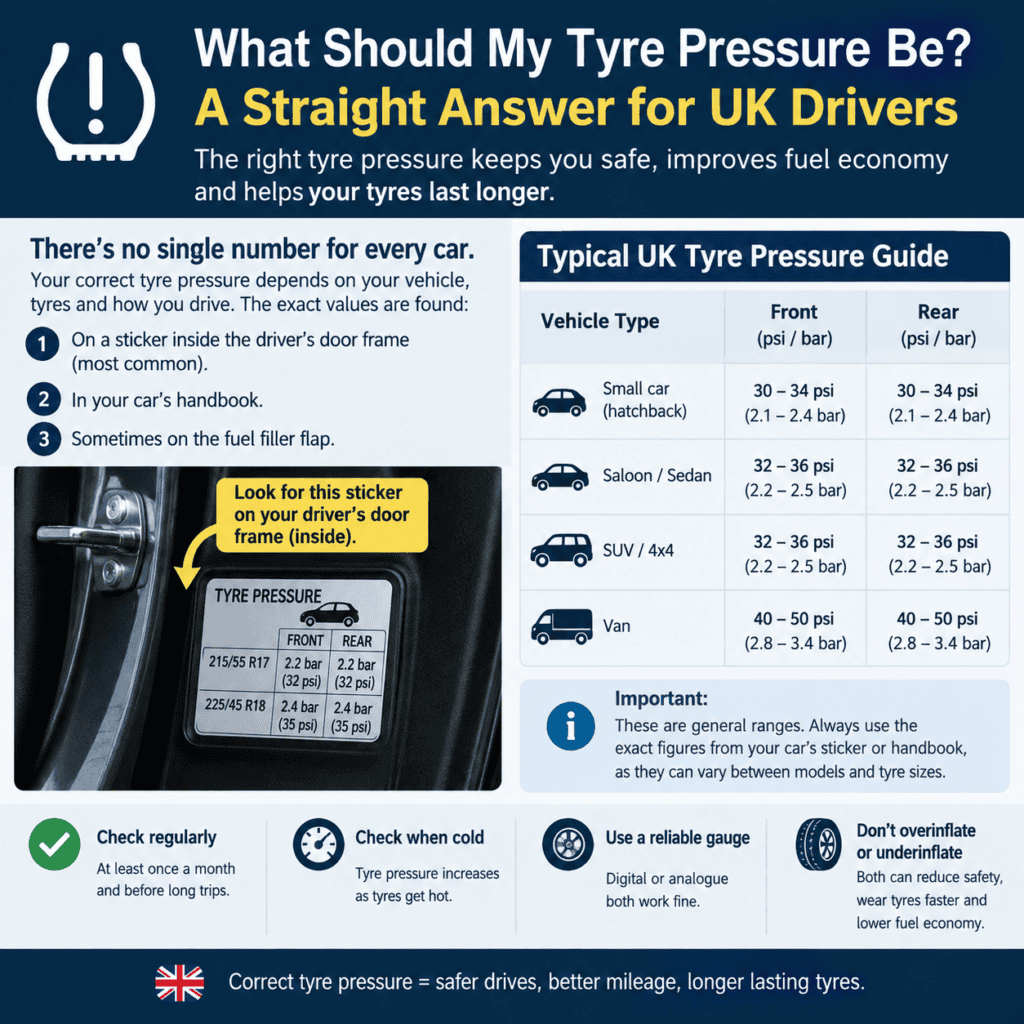
There is no single correct tyre pressure. It depends on your exact car, the tyre size fitted, and how much weight you are carrying. Anyone who gives you one number without asking what you drive is guessing. Here is how to find the right figure for your vehicle in under a minute.
Where to find your car's correct tyre pressure
Your manufacturer sets the correct pressures and prints them in three places. Check whichever is easiest to reach.
The most common location is a sticker inside the driver’s door frame — open the door and look at the pillar you would normally see when the door is shut. Some manufacturers put it inside the fuel filler flap instead, and almost all of them repeat it in the owner’s handbook.
That sticker will usually list two sets of figures: normal load and full load. Normal load is for everyday driving with one or two people. Full load is for a car packed with passengers and luggage, and the rear pressures in particular will be noticeably higher.
Typical pressures for UK cars
Most family cars sit somewhere between 30 and 36 PSI (about 2.1 to 2.5 bar). Smaller city cars are often a little lower, and vans, SUVs and anything carrying weight are usually higher.
Those are ranges, not recommendations. Two cars with the same badge can take different pressures if they are on different wheel sizes, which is exactly why the door sticker matters more than any figure you read online.
PSI, bar and kPa — what the units mean
Most family cars sit somewhere between 30 and 36 PSI (about 2.1 to 2.5 bar). Smaller city cars are often a little lower, and vans, SUVs and anything carrying weight are usually higher.
Those are ranges, not recommendations. Two cars with the same badge can take different pressures if they are on different wheel sizes, which is exactly why the door sticker matters more than any figure you read online.
How to check your pressures properly
Check them cold. Driving heats the air inside the tyre and raises the reading, so a tyre checked after a motorway run can read several PSI higher than it really is. Check before you set off, or after the car has been parked for a couple of hours.
Do not forget the spare if you carry one. A spare that has been sitting flat for two years is no use on the hard shoulder.
What happens if the pressure is wrong
Under-inflated tyres flex more, build heat, wear out on the outer edges and increase fuel consumption. Badly under-inflated tyres can overheat to the point of failure.
Over-inflated tyres have a smaller contact patch, wear out in a strip down the centre, and give a harsher ride with less grip in the wet. Both extremes cost you money and grip.
Frequently asked questions
Is 40 PSI too high for a car tyre?
For most family cars, yes. 40 PSI is well above the typical 30–36 PSI range and would give you a harsh ride, reduced wet grip and centre tread wear. Some vans and heavily loaded vehicles genuinely do specify 40 PSI or more — check your door sticker rather than assuming.
Should front and rear tyre pressures be the same?
Often they differ. Front-engined cars usually carry more weight over the front axle and specify slightly higher front pressures. When loaded, rear pressures typically increase more than front. Your door sticker will show both.
How often should I check my tyre pressure?
At least monthly, and before any long journey. Tyres lose pressure naturally over time even with no puncture — roughly 1 to 2 PSI a month is normal.
Does cold weather affect tyre pressure?
Yes. Pressure drops as temperature falls, by roughly 1 to 2 PSI for every 10°C. That is why TPMS warnings often appear on the first cold morning of autumn.
Need help with your tyres?
 Call 07888 861557 ·
  WhatsApp 07459 623445
Flat tyre, blowout or a tyre that keeps losing pressure? CarPal comes to you — at home, at work or the roadside — anywhere in the UK, 24 hours a day.