
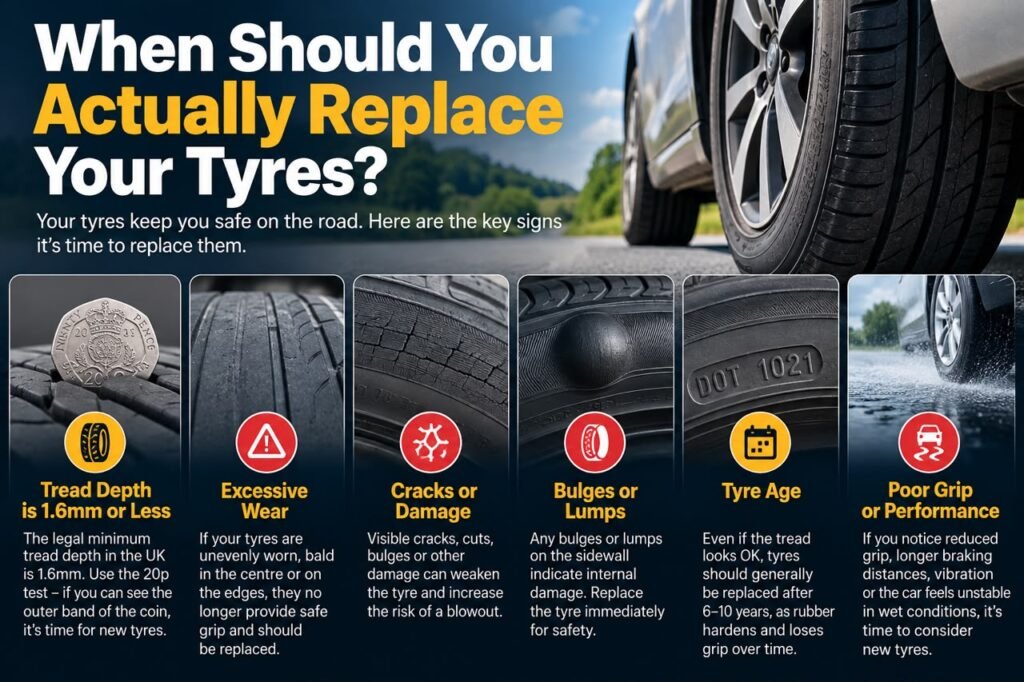
When Should You Actually Replace Your Tyres?

when should you actually replace your tyres?

A practical guide to when to replace tyres for UK drivers, from the CarPal mobile tyre team.

Reason one: tread depth

The legal minimum is 1.6mm across the central three-quarters, around the whole circumference. Below that the tyre is illegal, fails the MOT, and carries a fine of up to £2,500 and three penalty points per tyre.

Many safety bodies recommend replacing at 3mm because wet braking performance falls off noticeably below that. That is a judgement call, not a legal requirement.

Reason two: damage

Any bulge in the sidewall means immediate replacement. A bulge indicates the internal structure has failed and the tyre is held together by rubber alone — it can let go without warning.

Cuts deep enough to expose cord, splits, and significant cracking all mean replacement. So do punctures in the sidewall or shoulder, which cannot legally be repaired.

Reason three: age

Rubber degrades over time regardless of use. A tyre with full tread that is twelve years old is not a good tyre. Many manufacturers suggest considering replacement at around six years and replacing at ten regardless of tread.

This matters most on low-mileage cars, caravans, trailers and classic vehicles, where tyres routinely age out long before they wear out. Check the four-digit DOT date code on the sidewall.

Reason four: uneven or abnormal wear

If a tyre is worn out on one edge while the rest has tread left, it needs replacing and the underlying alignment problem needs fixing — otherwise the new tyre does the same thing.

Cupping, flat spots and vibration that does not resolve with balancing all point to replacement plus investigation.

Replacing in pairs

Replace across an axle where you can. Mismatched grip left to right affects braking stability, particularly in the wet.

If you are only replacing two on a front-wheel-drive car, the general guidance is to fit the new pair to the rear. Better grip at the back reduces the chance of oversteer in the wet, which is harder to correct than understeer.

Frequently asked questions

When should I replace my tyres?

At 1.6mm legally, or 3mm for best wet performance. Also immediately for any bulge or structural damage, and by around ten years old regardless of tread.

Should I replace tyres in pairs?

Ideally yes, across an axle, so grip is matched left to right.

Do tyres expire?

Rubber degrades with age. Consider replacement around six years and replace by about ten, checking the DOT date code.

Should new tyres go on the front or rear?

Generally the rear, even on front-wheel drive, because better rear grip reduces the risk of oversteer in the wet.

Need help with your tyres?

📞 Call 07888 861557 · 💬 WhatsApp 07459 623445

Flat tyre, blowout or a tyre that keeps losing pressure? CarPal comes to you — at home, at work or the roadside — anywhere in the UK, 24 hours a day

Related Tyre Services: Mobile Tyre Fitting,Puncture Repair, Area we cover

Scroll to Top