
Can You Drive on a Flat Tyre? The Honest Answer
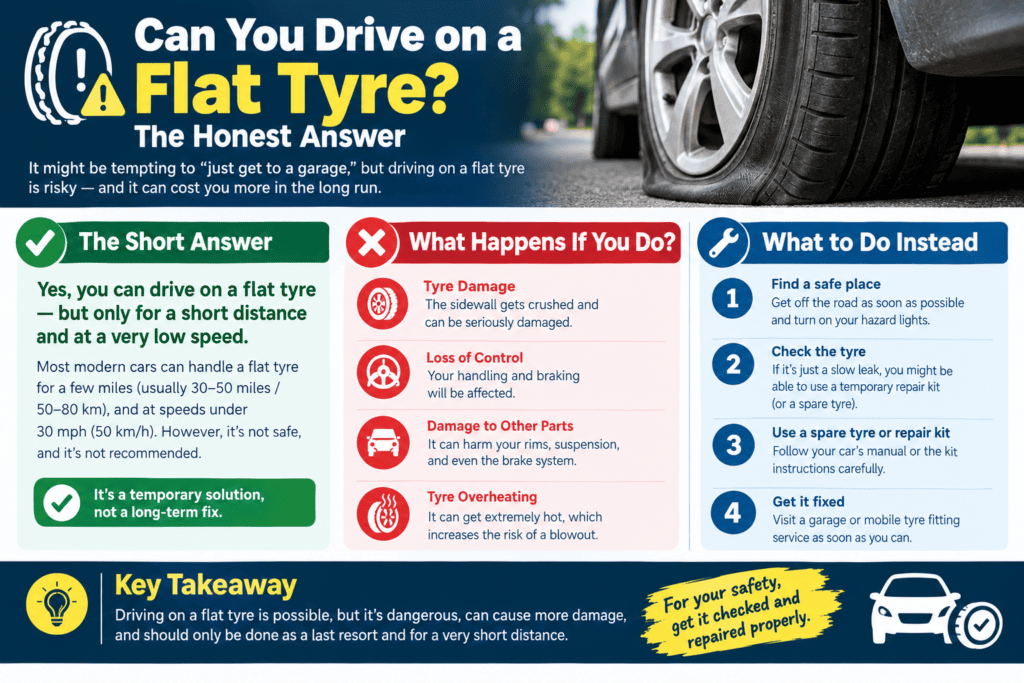
The short answer is no — not on a conventional tyre, and not for more than the few metres it takes to get somewhere safe. Every mile you drive on a flat tyre turns a repairable puncture into a scrapped tyre, and often a damaged wheel too.
What happens to the tyre
With no air in it, the sidewall folds over on itself and is crushed between the wheel rim and the road. That destroys the internal structure within a very short distance — often less than a mile.
Once that has happened, the tyre cannot be repaired even if the original puncture was a simple nail in the middle of the tread. A £35 repair has become a new tyre.
What happens to the wheel and the car
Alloy wheels are not designed to take road load directly. Driving on a flat can buckle the rim, and a buckled alloy either needs specialist refurbishment or replacement.
Beyond that, a deflated tyre drags heavily on one corner, which affects steering and braking, and in some cases damages suspension components, wheel bearings or brake lines. The repair bill escalates quickly.
What to do instead
- Slow down gradually and avoid braking hard or steering sharply.
- Get off the carriageway to somewhere safe — a hard shoulder, layby, side road or car park.
- Switch on hazard lights. On a motorway, get out on the left and stand behind the barrier.
- If you are in a dangerous position on a motorway, call 999 first.
- Then call for mobile tyre assistance rather than driving on.
The exception: run-flat tyres
If your car is fitted with run-flat tyres, you can drive on — typically around 50 miles at up to 50mph. That is the entire purpose of the design. Check your handbook for the exact figures.
Even then, drive to somewhere safe and get it sorted. Run-flats are limp-home tyres, not a permanent state.
Frequently asked questions
How far can you drive on a run-flat tyre?
On a conventional tyre, only far enough to reach somewhere safe — metres, not miles. Damage begins almost immediately.
Will driving on a flat ruin the tyre?
Almost always, yes. The sidewall is crushed between the rim and the road and the tyre’s structure is destroyed, making it unrepairable.
Can I drive slowly on a flat tyre?
Driving slowly reduces but does not prevent damage. The tyre is still being crushed with every rotation.
What if I have run-flats?
Then you can continue for a limited distance — typically 50 miles at up to 50mph — but get it replaced promptly.
Need help with your tyres?
📞 Call 07888 861557 · 💬 WhatsApp 07459 623445
Flat tyre, blowout or a tyre that keeps losing pressure? CarPal comes to you — at home, at work or the roadside — anywhere in the UK, 24 hours a day.
Related Tyre Services: Mobile Tyre Fitting,Puncture Repair, Breakdown Recovery