
What Are Run-Flat Tyres, and Are They Worth It?
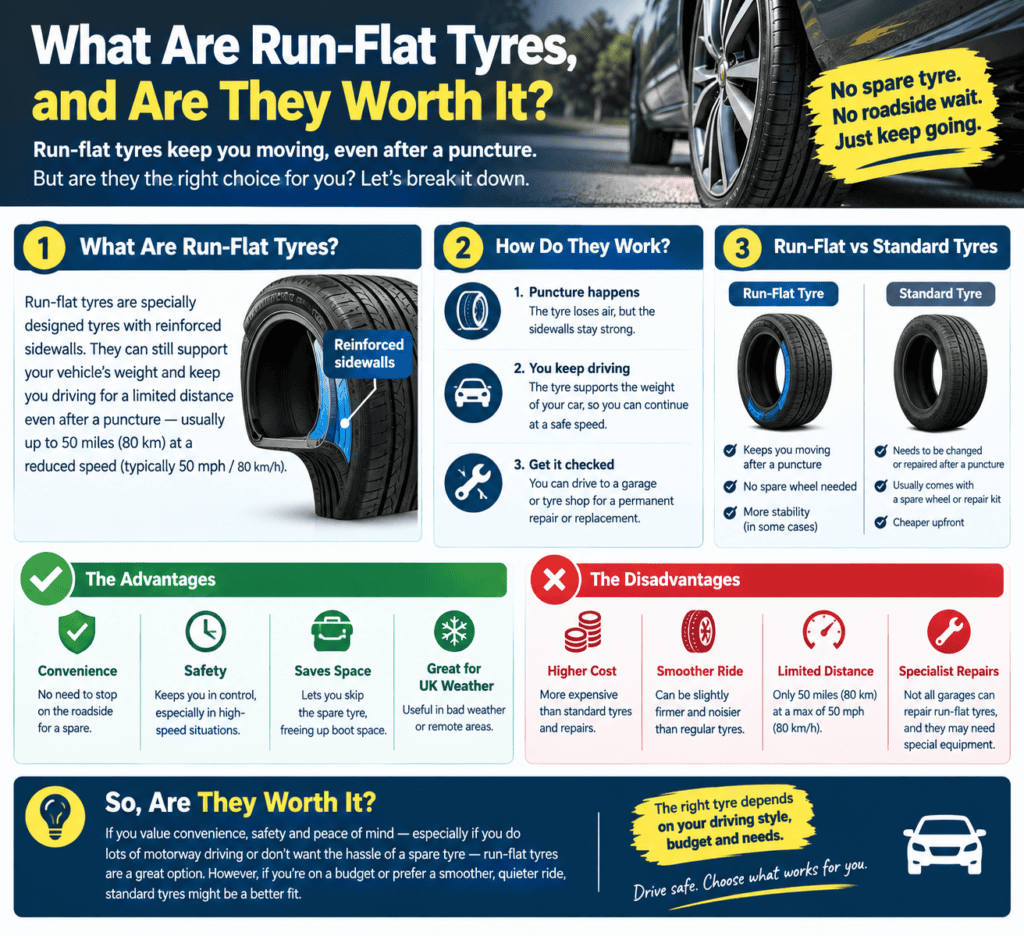
Run-flat tyres are designed to keep working after they lose air, so you can carry on to a safe place instead of stopping at the roadside. They are standard on a lot of BMWs and MINIs and increasingly common elsewhere. They also cost more, ride harder, and have some real limitations worth understanding before you replace them like for like.
How they work
A run-flat has substantially reinforced sidewalls. On a conventional tyre, the air pressure holds the car up and the sidewall collapses the moment pressure is lost. On a run-flat, the sidewall itself is strong enough to carry the weight of the car for a limited distance with no air in it at all.
Manufacturers typically quote around 50 miles at up to 50mph, though the exact figures vary. That is enough to get off a motorway and to somewhere safe, which is the entire point.
Why cars are fitted with them
The main reason is safety. A sudden deflation at speed on a conventional tyre can be dramatic; on a run-flat it is far more controlled.
The secondary reason is packaging. If the car can limp on a flat, it does not need to carry a spare wheel, which frees up boot space and saves weight. That is why most run-flat cars have no spare at all — which becomes important if you ever decide to switch away from them.
The downsides
They cost more than conventional tyres, typically noticeably so. They ride more firmly, because a stiff sidewall is exactly what absorbs bumps on a normal tyre. And they are heavier, which affects both ride and fuel consumption slightly.
They also need specialist fitting equipment. Forcing a run-flat onto a standard tyre machine risks damaging the bead, the tyre or the alloy. Not every fitter carries the right kit.
Can run-flats be repaired?
Usually not, and most manufacturers advise against it. Once a run-flat has been driven on while deflated, the sidewall has taken structural load it was not designed to take repeatedly. Any internal damage is invisible from the outside.
There are exceptions where the tyre has not been run flat at all and the puncture is small and central, but the default answer from most manufacturers and tyre makers is replace rather than repair.
Can you mix run-flats and normal tyres?
It is strongly discouraged. The handling characteristics differ enough that mixing them across an axle affects balance and braking. If you switch away from run-flats, do all four — and buy a tyre inflation kit or spare, because your car almost certainly does not have one.
Frequently asked questions
How far can you drive on a run-flat tyre?
Typically around 50 miles at up to 50mph, but check your specific tyre and vehicle handbook — figures vary by manufacturer.
Can you repair a run-flat tyre?
In most cases no. Once driven on while deflated, the sidewall may have hidden structural damage. Most manufacturers recommend replacement.
Are run-flat tyres more expensive?
Yes, usually meaningfully more than an equivalent conventional tyre, and they need specialist fitting equipment.
Can I replace run-flats with normal tyres?
Often yes, but do all four, and bear in mind your car probably has no spare wheel. Check your handbook, as some vehicles’ suspension is tuned specifically for run-flats.
What does RSC mean on a tyre?
RSC stands for RunFlat System Component — BMW’s designation for run-flat tyres approved for their vehicles.
Need help with your tyres?
📞 Call 07888 861557 · 💬 WhatsApp 07459 623445
Flat tyre, blowout or a tyre that keeps losing pressure? CarPal comes to you — at home, at work or the roadside — anywhere in the UK, 24 hours a day.
Related Tyre Services: Mobile Tyre Fitting,Puncture Repair